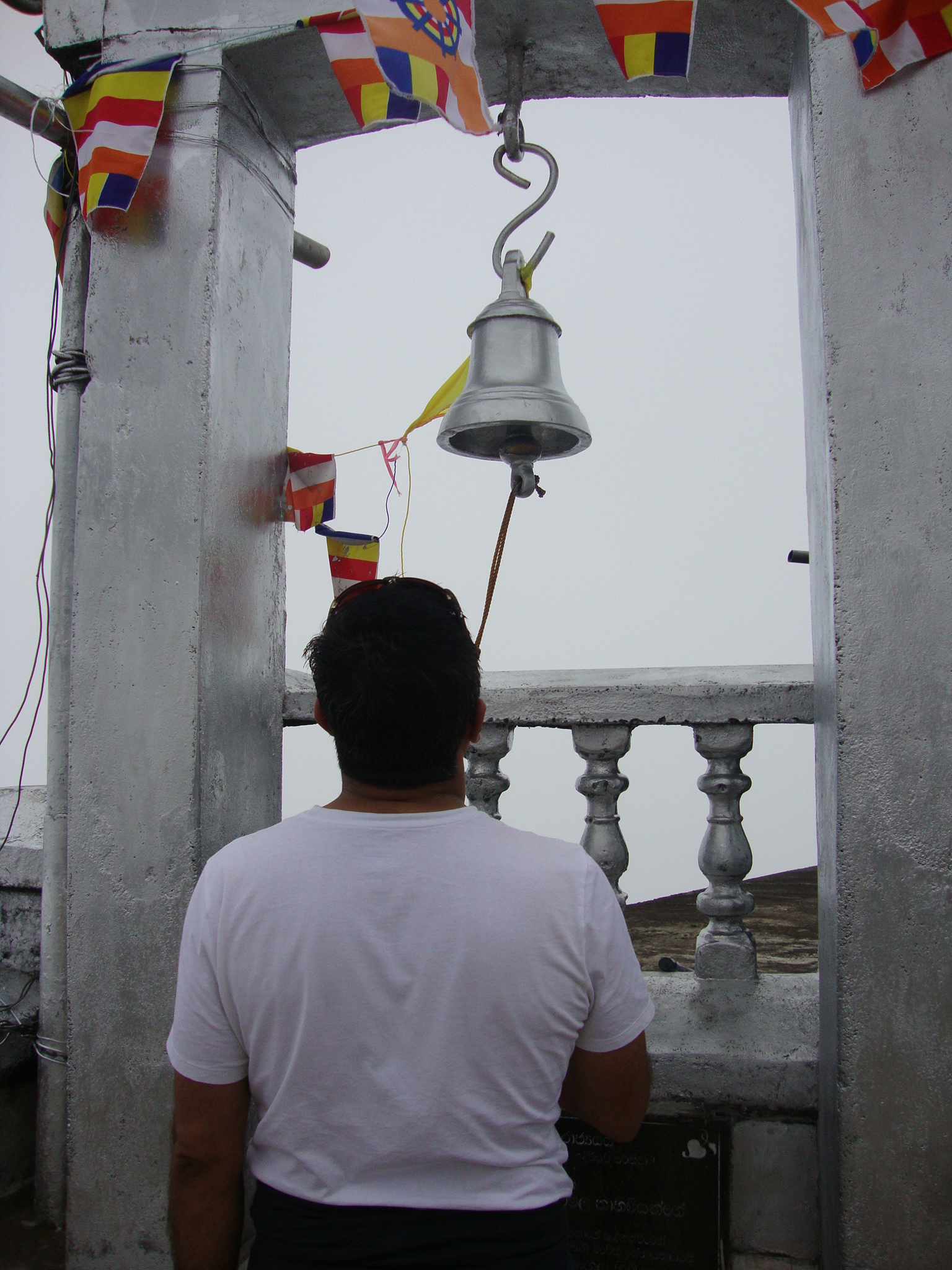
Adam’s Peak…A Traveler’s Tale

We travel, some of us forever, to seek other states, other lives, other souls.
– Anais Nin

Wow we are in 2013, the world hasn’t ended…….yet, and we are back from our travels. This new year was special as we were halfway across the world in Sri Lanka, climbing Adam’s peak on New Year’s day. Adam’s peak is a sacred pilgrimage spot for persons of all faiths in Sri Lanka. It is a conical mountain at an elevation of 2243 meters.  It is common belief that Lord Buddha during his third visit to Sri Lanka left his footprint on this sacred mountain. The Muslims and Christians believe it is the foot print of Adam after he was expelled from the Garden of Eden, and landed on top of the mountain. Some believe it is the footprint of St Thomas and Hindus regard the footprint as the footprint of Lord Shiva.

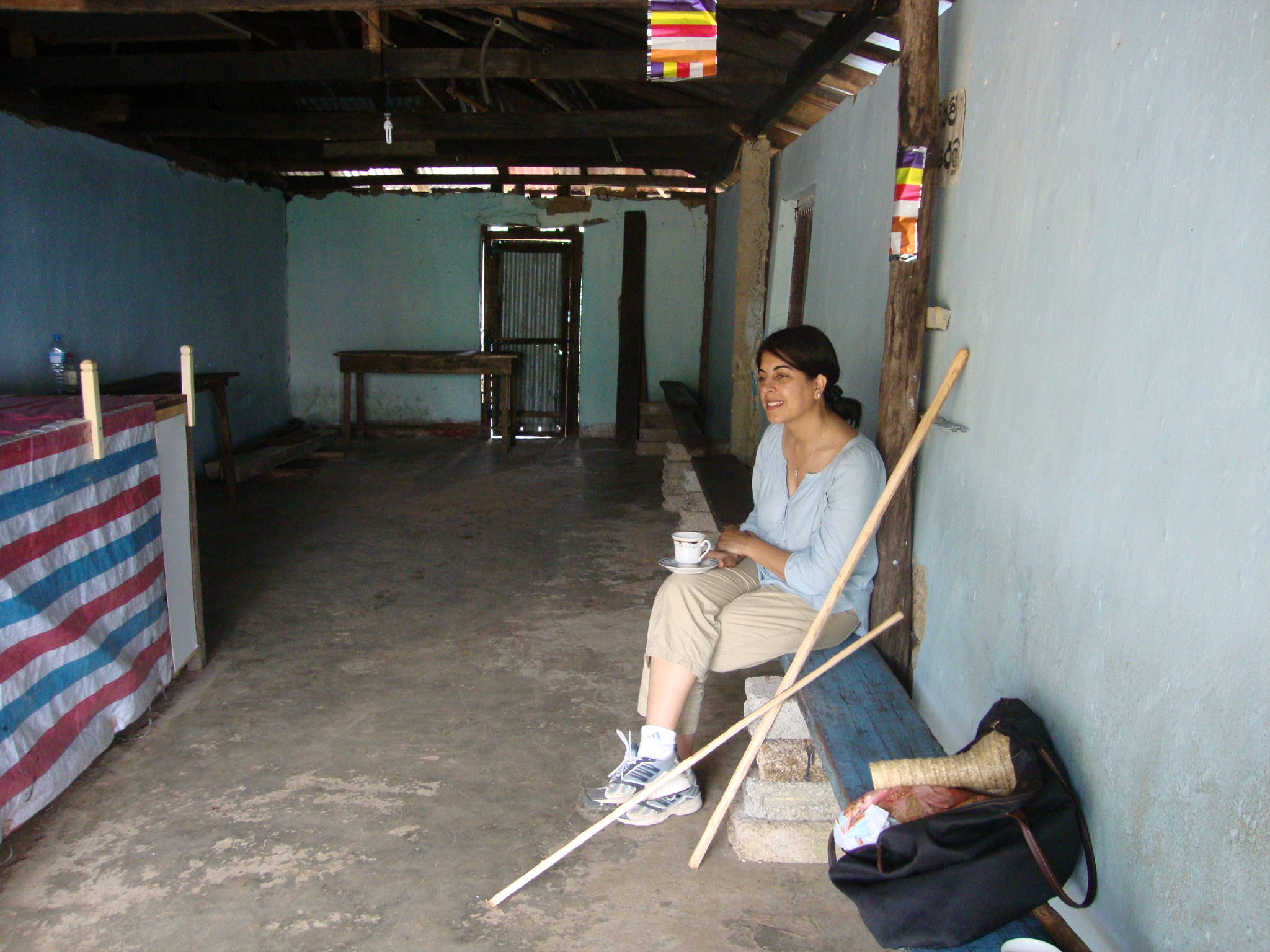
DSC01930The 6 hour hike up is surrounded by breathtaking views, and long opportunities for introspection. As we hiked we came across people of all  faiths. Each person carried with him a different belief but the same zest and zeal. Each person starts his/her journey with a different conviction, a different set of beliefs, but ends it by converging at the same point. The tip of the peak doesn’t change, it stays the same, even though down below it’s interpretations differ.

DSC01925The adventure by far was the most physically strenuous thing I have ever done, but definitely worth every aching muscle. During the hike we came across children, elderly and even physically disabled people, amazed by their will, wondering each step of the way how they would complete their journey. But may be it is their faith, the belief in something higher, something bigger, that gives people the strength to continue forward and hence each faith has formed their own connection with the peak. But it is not the peak that needs the connection, it is the traveler’s need.

The more we travel the desire to seek other states, other lives and other souls continues to grow. The boundaries start to vanish, the differences begin to disappear and you realize no matter how different one appears on the surface, our soul’s journey is the same. We are all eventually converging towards the same eternal truth. Our class, mode of transport, belongings might be different, but our destination is the same.

Child Free vs Childless

Recently I had a very interesting encounter. I was introduced to someone and as we were sitting and chatting she asked me if I had children and I replied ‘no we don’t have children’. Somewhere along the conversation the poor lady apologized to me in case her question made me feel awkward. I quite confidently answered ‘no’, not quite sure why her question would make me feel awkward. Then she shared how her husband and her had been trying for many years and she knew exactly how it felt. As I listened attentively to her I suddenly realized……..she is assuming we have been trying to have a child. I tried sympathizing with her situation and at the same time explaining to her that WE DON’T WANT CHILDREN, we are not childless we choose to be child-free.

The interaction left me quite amused. It made me wonder though why people assume not wanting children is synonymous to not being able to have children. Why is it not an option to not want children. I often find people, especially from Asian cultures, unable to grasp this concept.They automatically assume something is ‘broken’.

Here are some of the reactions and arguments we have heard over the years and our thoughts on them:

you should really try, they have made so much progress in the medical field : this one always leaves me amused and speechless, and most of the time I choose not to even qualify it with a remark. Actually to be honest it is easier to let them believe it is a medical issue then try to explain why we don’t want children 🙂

they are so many options, if nothing works at least think of adoption: ok adoption is not a last resort, nor should it be plan C, you either are comfortable with adoption or not, it is not a consolation prize.

you will regret your decision: just as you might regret yours of having children, getting married, etc.

what will happen when you are old: we are not sure if we will get to be old, and if we do, our future is as uncertain as yours.

but you both are so nice you would have such lovely children: I don’t think genetics quite works that way, good parents = good children.

you would be great parents: no guarantees there, every parents tries to be a great parent.

have them and give them to us, we will raise them: and the point of the whole exercise would be…..

It’s really not that bad….well then how bad is it

who will you love and call your own: Many people believe that to truly and unconditionally love a child it has to be their own ‘production’, so to speak. I guess my husband and I have never felt that in order to love a child he/she has to be from us. We both love our nieces and nephews, we love our friends’ children, I love the children I work with, and yet we are very comfortable not having them 24×7.

you are being selfish: how is not wanting children any more (or less) selfish than wanting children. Most people who have children are also doing it for selfish reasons: be it the desire to love someone, the desire to play with someone, the desire to propagate your seed, the desire to not be alone in your old age, or just a mindless choice towards the natural progression of life. With a 7 billion world population I am note sure which is a more selfish choice

children strengthen marriages: children bring out what is already in a marriage, if it is a happy marriage they add to it and if it is a bad marriage they only make it worse.

we know what it is like to not have children we waited before we had ours: making a conscious choice to not have children is not the same as waiting to have children. It is like saying we know what it is like to lose a spouse because we were single once. It is a very different state of mind, one is a waiting period with the clear end goal of having children and the other is  a consistent lifestyle choice.

and my all time favorite from a dear aunt who after hours of trying to convince me to have a child, finally declared ‘no one does not want to have children people only say that when they cannot have children’.

What I find  interesting is that when someone tells you that they are getting married you do not tell them”you really should think about it, are you sure you want to be married all your life, you might regret being married”. Case in point being that when someone tells you they do not want children it is not a debate, it is not a discussion and nor is it a propagation of an ideology. They are simply stating a decision and just as you would respect all other (conventional) decisions people take, you also need to respect this one.

So finally after all our interesting encounters my husband and I have decided to call ourselves child-free. Because childless implies the lack of a child in one’s life, which could be medical, circumstantial, temporary or permanent. Child-free is a conscious choice, it is a gain of certain freedoms or lifestyle options, which one deems valuable.

One of my favorite quotes on children is from Khalil Gibran:

Your children are not your children.
They are the sons and daughters of Life’s longing for itself.
They come through you but not from you,
And though they are with you yet they belong not to you.

You may give them your love but not your thoughts,
For they have their own thoughts.
You may house their bodies but not their souls,
For their souls dwell in the house of tomorrow,
which you cannot visit, not even in your dreams.
You may strive to be like them,
but seek not to make them like you.
For life goes not backward nor tarries with yesterday.
Virtually Speaking

In this digital age where we have the internet, VoIP, email, social networking, 4G, smart phones, WiFi, various software and hardware that give us access to the world, to endless possibilities, to family, to friends, a means to stay connected………one has to wonder: Are we really more connected? Has technology made our relationships more meaningful? Who are our relationships with: people or machines? Do our new virtual identities and relations really exist? And if so what do they mean?

With more and more tools to share and stay connected with people: be it face-time, Skype, Facebook, twitter, etc, are people really sharing more or less? We are showcasing our life but are we really sharing our life. Because sharing is not just about uploading pictures in which we look great, it is not about advertising every vacation we have ever taken or broadcasting our latest purchase. We are showcasing every ENVIABLE moment of our life.

If you look around you will find that for most of us as the radius of our friends grows the people we can actually share things with is shrinking. Our lives have become one big showcase which we continue to adorn everyday using various  tools:Facebook , twitter, pinterest…. carefully avoiding any ugly, sad, or real moments from slipping in.

My husband and I have made a deliberate choice not to be on Facebook. Don’t get me wrong, social networking  is a great tool, with great capabilities and endless possibilities. However I am not comfortable with what its use has been reduced to and what it represents for most people. Since you cannot find us on Facebook, Do we really exist?

Even though I am not on Facebook, social networking has redefined words I thought I knew. Take a look at these icons and then take a minute to think:  what they mean and how they might have changed your life:

ImageImageImage

Not too long ago in order to become a friend or call someone your friend it took more than a click. It took a few meetings, investment of time, emotions and a commitment. Because of what it entailed  people generally chose their friends carefully and spent time getting to know people before they called them a ‘friend’. Being a friend is not about clicking the ‘add as friend’ button, it shouldn’t be. Someone I have very little to say to,  I would avoid meeting on most occasions, why should I let them into my life with the click of a button. What does it mean to call someone a ‘friend’? Who is a friend? Is a friend just a number? And friends we cannot trust, love or even share with, should it then matter if we have 300+ of them online.

I find myself surrounded by people who are constantly connected. Sharing every moment of their life with thousands of people around the world, but unable to experience life itself. They have time to update their status, tweet, comment on pictures,  but can’t make time for people around them.  It is funny how not being on Facebook creates a need for my husband and me to meet with friends and catch up, but for the rest of the world they are already caught up…….virtually!

In this race to exist and survive in the virtual world many of us have stopped investing, experiencing and growing in the real world.  We have stopped investing  time building human relations. We have little time left to introspect about ourselves because we are too busy creating a virtual identity for ourselves. We have little time for human interaction because we are too busy texting, talking, emailing, twitting.We are in a monogamous relationship with our machines. Since they cannot talk back, we have stopped listening, we are only talking.

Right now I have 0 Friends, 0 Likes, 0 Comments……and I do not seize to exist. I am ALIVE!

You might not be able to find us on Facebook but can always connect with us over dinner and a good conversation. I

Chapters

We all have new chapters opening in our life everyday. But life’s chapters are a mystery to me. Some we chose to open, some open by themselves, some close as quickly as they opened, some remain open with us till the end, some chapters we deliberately close, some chapters close even when we want them to remain open.

Every new phase in our life, every new turn, every change inevitably is the beginning or end of a chapter. I once heard someone say: “you know you are getting old when slowly the chapters in your life start closing, and you know it is time to go when there are more closed chapters than open ones left”.

Until recently I never had to think about closing chapters, may be that was youth, but life just seemed about opening new chapters. I guess when we start the book of life, we start by filling it with chapters. Every new relationship, every new encounter, every life stage seems to be the beginning of a new chapter.

When we are young we feel  that we are the authors of all the chapters in our lives, we are the deciding factors, we will decide when to open and when to close a chapter. But with time you realize that we do not control all the chapters in our life. People who surround us, people we love, people we interact with, often are the coauthors of our life’s chapters. Every new relationship, every new encounter, every life stage in THEIR life might unknowingly lead to the beginning or end of a chapter in our life.

It is only through experience that we learn when to open and when to close a chapter, we learn to accept the inevitable beginning and end of a chapter. We realize that some chapters of our life have many co-authors. The destiny of these chapters we do not decide alone, we cannot write an ending for them, we cannot chose a new beginning for them, we cannot keep chapters open past their expiration date, we cannot change the characters at will nor can we keep characters alive once they are gone.

This summer for the first time it dawned on me that it is time to close some of the chapters in my life, something I never really had to do before. I thought I could keep them open by not writing an ending, but the ending was written a long time ago……..I just didn’t see it.

I was too busy writing my own story.

Great Minds Discuss Ideas, Average Minds Discuss Events, Small Minds Discuss People….

I love this quote and every time I read it I am reminded that I have a long journey ahead from small, to average, to great. A journey I try hard to make progress on each day. I don’t know if I will ever be like one of those great minds, but I feel that  most of us have a part that is great, a part that is average and sometimes a part that can be small. With smallness being the lowest common denominator we share with most people, or safely fall back to.

Through life’s experiences, our circumstances and most of all our choices we consciously or sub consciously decide which part we want ourselves to be governed by, in which proportion we want each aspect to define us and coexist inside us.

But I find more and more people wanting their  lives to be above average, when it comes to their homes, their cars, their lifestyles, their life partner, their children, but are perfectly comfortable letting their minds be small. Some of us have not even started the journey of upgrading our minds, we are still too busy upgrading our cars, furniture, homes, handbags and friends. In the process of achieving greatness in material things, be it fame, popularity, vanity, we have become very small as people. May be that is our choice, may be its our destiny or maybe it is our karma.

I do feel one thing for sure that growing up I used to see more people with small things, average lives but Great minds, now I meet more and more people with big things, great lives but small minds.

From Religion to Spirtuality…..the road less travelled.

 “The religion of the future will be a cosmic religion. It should transcend personal God and avoid dogma and theology. Covering both the natural and the spiritual, it should be based on a religious sense arising from the experience of all things natural and spiritual as a meaningful unity. Buddhism answers this description. If there is any religion that could cope with modern scientific needs it would be Buddhism.”(Albert Einstein)

I recently came across this quote from Albert Einstein. I thought it was interesting as my Husband and I have often had this discussion.

I don’t think organized religions; be it Islam, Christianity, Judaism,  have a role left to play in our lives today. They seem inept at addressing social and personal issues arising from a modern way of life. The focus of organized religions was around organizing society and bringing a civil order.

Now as societies have become civilized, individuals are no longer looking towards religion to answer questions pertaining to moral conduct, inheritance, nutrition, Science, etc. They need religion for personal growth, for spiritual development and organized religions seem to be lagging in the realm of individual spiritual growth. They have nothing more to offer other than religious theology and dogma.

Religion seemed to have outlived its original purpose. It is now struggling to  find a role for itself  in modern life: through fear, through terror, through religious clergy, through traditions, but is still unable to find  a well defined purpose for its existence. Extremism and fundamentalism are its last attempt to survive, to slow down the natural evolution and progression of civilization.

As the world and our lives become more global,  our problems just like our needs are no longer limited to geography, race or culture. We need an ideology that brings  people, cultures, races and humanity together.  Ideologies that build on commonalities rather than differences. How can ideologies that are too small to even share ‘their’ God, hold within them big solutions.

Religion was the product of a need: a need of a time, a need of a people and a need of a civilization. In the same way its demise is also the need of the people, a need of modern civilization and a need of humanity.

God and spirituality will continue to exist even without religion.

The Inheritance of Loss

I have often wondered why we lose more than we inherit with inheritances. Why inheritances get lost between ego, greed and a false sense of rightfulness? When I am trying to clear my thoughts, I find it helpful to just browse through a dictionary to see  the ‘rational’ definition of a word. I thought it was interesting that Inheritance is synonymous with: bequest, birthright, heritage, legacy.

When you think of ‘Inheritance’ as a ‘birthright, heritage or legacy’, it is easier to understand why it carries with it the weight of generations. For some inheritance is just the transfer of tangible or material assets. But I think inheritance is not just an exchange of tangibles, it is the sharing and division of a loved one’s life and legacy. Sometimes an attempt to hold onto a bygone era, to keep alive cherished memories or to carry a piece of a loved one, long after they are gone.

I see most people spending their lives trying to accumulate, create or secure an inheritance for their children. Amassing wealth, position, titles, anything and everything which could possibly be passed on. I don’t know if it is the primal instinct to protect and ensure the survival of your offspring or is it just the propagation of one’s own ego and legacy.

But somewhere in this material division the intangibles: values, memories, and love get lost . Siblings with whom all your life you shared the intangibles: your parent’s love, your parent’s time, your parent’s lives, when the time comes to divide the tangibles you forget to share. Some even feel justified usurping others shares as their birthright, securing ‘their’ legacy for ‘their’ children, unknowingly creating a new cycle.

A cycle in which the individual will inherit material assets, but will lose loved ones, lose shared memories, lose companions of their young and old age and even lose the legacy. Just like many before them, their life’s efforts and strives become an Inheritance, an Inheritance of Loss….

The Born Identity…..

The partition of India and Pakistan not only created a new nation but it also created a need for a new identity for the 27 million odd people who found themselves now in Pakistan. They could no longer call themselves Indians as they had been for several centuries. Instead of continuing to identify themselves with the ‘Indians’, who they were culturally, ethnically, and genetically a part of, they tried to find roots and identities in the newly emerging Arabs. Just as the newly found nation was finding its roots in religion, so were the people, tracing back their ancestry to the nomads of Arabia.

Almost 65 years after partition, Pakistan continues its quest for an identity. General Zia tried hard to convince Pakistanis and the World that they were Arabs, but Zia ul Haque’s policies, Sharia Law, or an Islamic state does not make Pakistanis Arabs.

Even today amongst all the chaos, upheaval, political and social unrest, you continue to see their resilience and determination pulsate in the streets. You can see the strokes of creativity in their art, you can hear the notes of optimism in their music. When will Pakistanis wake up and realize they have much more to share with their Hindu, Sikh and Christian neighbors than their Arab ideals. They have much more to learn from their enemies than their allies. They have much more to emulate from people they share a common genealogy with than people who they share a common religion with. When will Pakistanis wake up and reclaim their identity….

Invisible Shackles

As I look around me, I find more and more woman wearing shackles. These are not woman I see in villages, they are not woman I see in shelters, these are not women I see on the streets, these are not uneducated women. These are women  I see at coffee mornings, clubs, dinners and endless parties. These are women with designer handbags, expensive cars, Gucci shoes. These are women oblivious to the shackles they wear everyday.

Many of them deny it , many are oblivious to them, some hide it with designer accessories, some have accepted it, and some identify with it. These shackles come in all sizes and colors, they can be tight or loose, heavy or light, they are not made of metal, you can’t see them, you can’t even feel them most of the time, until someone decides to pull the strings on them.

They do not violate any human right, you can not complain about them, they are not overtly forced, but subversively placed, they are worn by each individual by their own choice and hence can be removed at any time, yet their weight has bogged woman for centuries.

Expensive cars, Louis Vuitton bags, Prada shoes, or Chanel Sunglasses can not hide their ominous presence. These are not shackles of society, gender or religion, which many believe they have broken free of. They are shackles of economic dependence………..

Be it countries, institutions or individuals, once you are financially dependent you have pawned your freedom to think, to question and to voice. If only these women stepped out of their designer facades and woke up to the reality that their freedoms are only as good as the men around them chose them to be. A wise person once said ‘the worse  form of control is financial dependence……it takes away the freedom to be you’.

The S Word…

‘Socialism’…why do more and more people seem to be developing a phobia of the S word? Why do Socialism and Capitalism seem to be two mutually exclusive choices?

Corporations and the wealthy elite seemed to have found the ‘S’ word to protect their growing greed and needs.  Any change that effects the interest of the elite or big corporations is categorized as a “socialist” policy.  National interest seems to be taking a back seat to increasing corporate and individual gains. The irony is that those who have the most to benefit from more Socialist polices are it’s biggest opponents, while the elite watch in quiet amusement how the lower and middle classes safely guard their growing wealth under the guise of ‘capitalism’.

If you look up the meaning of Capitalism it is defined as :

An economic system that became dominant in the Western World following the demise of feudalism.There is no consensus on the precise definition nor on how the term should be used as a historical category.There is general agreement that elements of capitalism include private ownership of the means of production , creation of goods or services for profit, competitive markets, and wage labor . The designation is applied to a variety of historical cases, varying in time, geography, politics and culture.

It is evident that Capitalism has evolved over the years, from its conception by Adam Smith, as the “Invisible Hand”, to Reaganomics. However today it seems to be reduced to an ideology over run by powerful lobbies and big corporations. It is suffering the same fate as many other ideologies have in the past. It seems to be serving only the interest of a few, and making the rich richer and poor poorer. The U.S. being a classic example of these excesses.

The Health care debate in the U.S. is a great example of how the ‘new’ interpretation of Capitalism has made U.S. one of only three developed nations without a universal healthcare system for all. The other two happen to be Mexico and Turkey, which have the excuse of being poorer than the rest. More money per person is spent on health care in the USA than in any other nation in the world,and a greater percentage of  total income in the nation is spent on health care in the USA than in any United Nation member state, except for East Timor. Although not all people are insured, the USA has the third highest public healthcare expenditure per capita, because of the high cost of medical care in the country.

A 2001 study in five states found that medical debt  contributed to 46.2% of all personal bankruptcies and in 2007, 62.1% of filers for bankruptcies claimed high medical expenses.The high costs  paid by U.S. companies for their employees health care put them at a competitive disadvantage. But powerful lobbying by pharmaceutical companies and medical associations will not lower health care cost in the U.S or allow any kind of healthcare reform. Warren Buffet said “that kind of a cost, compared with the rest of the world, is like a tapeworm eating at our economic body.”

If this is Capitalism then we need to revisit our interpretation of Capitalism and start using more of the ‘S’ word. In order for Capitalism to survive, like any other philosophy, it has to be able to adapt to a changing world, and evolve to encompass solutions for changing global needs.  It needs to borrow best practices from other ideologies, even ‘Socialist’. Critics of Capitalism have for long argued that capitalism is associated with: unfair and inefficient distribution of wealth and power; a tendency toward market monopoly and oligopoly. How the current interpretation of Capitalism fairs in the midst of increasing globalization, aging economies, personal greed, corporate monopolies, environmental issues, is yet to be seen.

But Americans and the world need to ask themselves is Capitalism an economic ideology or has it become a political ideology. As Edward O. Wilson said “Political ideology can corrupt the mind and science”.